01
Unmanaged adoption
AI tools proliferate outside policy and standards, creating invisible risk and exposure across the organisation.
Meridian helps organisations make AI visible, governed and resilient — connecting strategy, ownership, runtime control, evidence and continual improvement into one operating capability.

Productivity gains are immediate. Strategy, ownership and operating discipline often arrive later — leaving organisations exposed to risks they cannot see, explain or recover from.
AI tools proliferate outside policy and standards, creating invisible risk and exposure across the organisation.
Responsibility gaps lead to duplicated work, changes in access and confusion at handover.
Sensitive data moves across tools and systems without visibility into access, transformation or use.
Important context, decisions and prompts are orphaned or deleted with no audit trail.
Each new use case adds complexity without reusable controls — creating cost, risk and friction as scale increases.
Meridian connects governance, architecture, controls, monitoring and continual improvement into one enterprise capability.
A complete operating cycle that connects strategy and intent to assurance and scale — driving visibility, control and resilience across the AI estate.
A common system of record for AI inventory, ownership, access, data, decisions, evidence, risks and controls. The live memory of the operating model.
The technical layer where policies, guardrails and signals are enforced — across systems, workflows, people and AI agents in production.
The Meridian Framework helps organisations move from point-in-time governance to living AI management. Readiness opens the entry gate; quarterly maturity reviews keep the cycle improving.
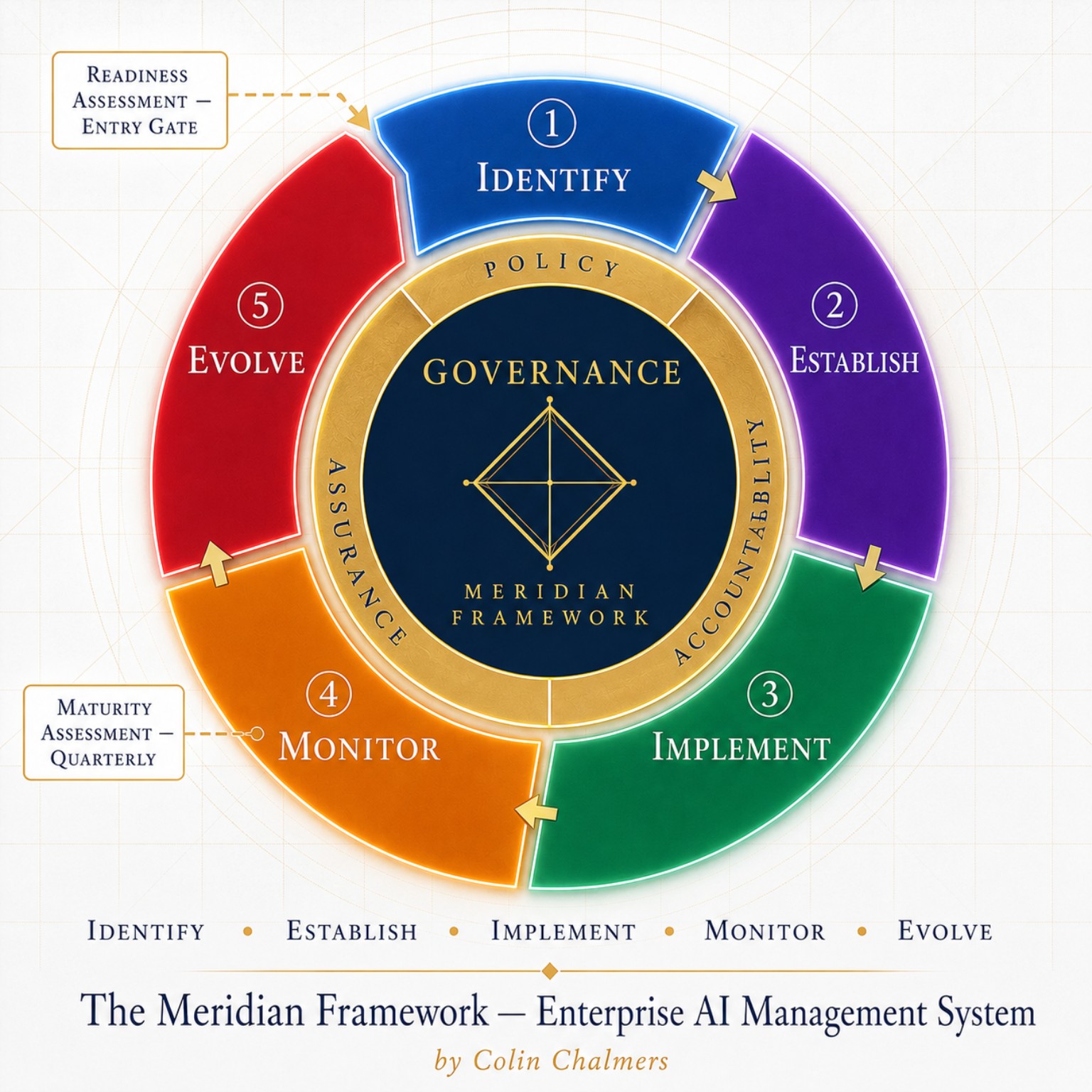
Know what AI exists, who owns it and where the risks are.
Define policy, accountability, risk appetite and operating model structure.
Build controls into platforms, workflows, tools and integrations.
Measure performance, risk, cost, incidents and generate audit evidence.
Use findings and evidence to improve the next operating cycle.
Policies describe what should happen. Runtime controls determine what may happen. Evidence shows what did happen.
Named identities, accountable owners, clear mandates and approved business purposes.
Access checks, model routing, data controls, tool permissions, human approval and stopping rules.
Managed providers, governed data, controlled actions and measurable business outcomes.
Start with a practical baseline, establish the managed operating capability, then sustain assurance and controlled scale as AI adoption grows.
Do we know what AI we have, where the risks are and what to address first?
Can we deploy and operate AI with confidence?
Can we scale AI and increase autonomy safely?
We are speaking with organisations that want practical visibility and control without slowing down innovation. Tell us where you are today, and we will explore the next sensible step.